
Scientific Publications
Please find a short description, link to the publisher, and possibly a video and honest thoughts about the researched topics.
Published in 01 April 2026, IEEE Open Journal of the Communications Society – PhD Thesis in Space Technologies
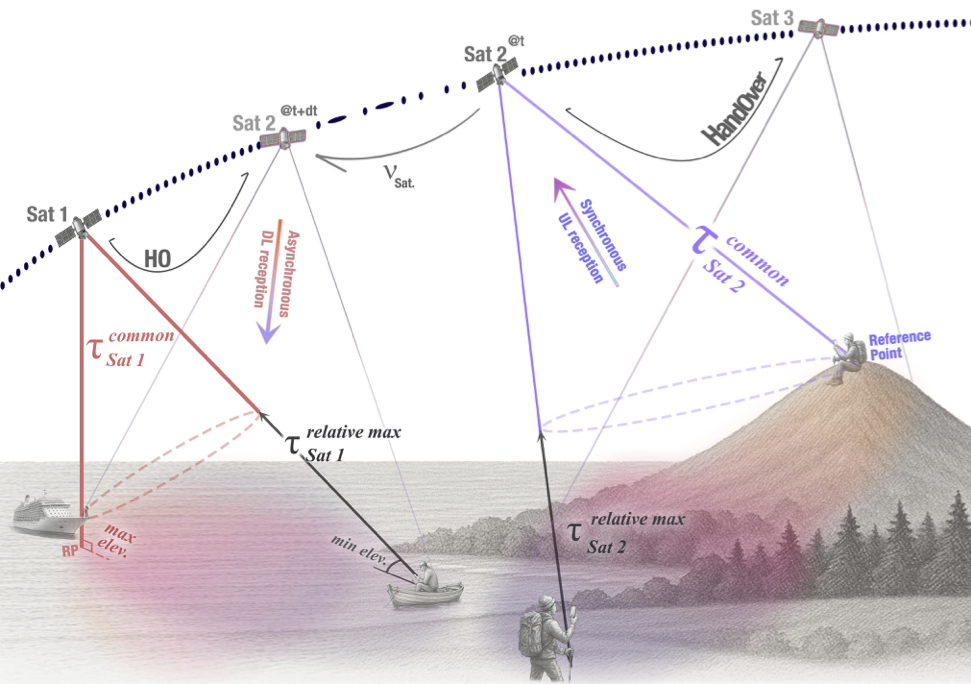
Accessing non-terrestrial networks (NTN) via existing 4G/5G handheld devices without positioning information presents significant challenges in achieving precise synchronization between a gNodeB and hundreds of users dispersed across an NTN cell. While terrestrial communication standards limit the relative delay between the center and edge of coverage to 200 km, multilayered NTN can introduce user-specific delay variation spanning thousands of kilometers. To address this challenge, we reeingeer the receiver’s Random Access (RA) preamble detector to achieve robust detection and Transmission Arrival (TA) estimation of scattered users with unknown but deterministic differential delays. The proposed Physical layer algorithm, termed Mirage detector, aligns with current 3GPP NTN standardization efforts and is forward/backward-compatible with future/earlier releases. Mirage detector leverages a dynamic Striding mechanism for multiple hypothesis testing, making it resilient to high false alarm rates caused by signals arriving beyond their nominal duration. Mirage also efficiently supports multiuser detection, enabling rapid resynchronization during frequent handovers—approximately twice per minute per Connected UE—while minimizing computational load of the transceivers. Extensive simulations results validate the advantage of the proposed Mirage detector that enables reliable multilayer connectivity for hundreds of legacy devices within the access occasion periodicity, without requiring hardware upgrades or any self-localization capability.
Published in 26 February 2024, Front. Commun. Netw., Aerial and Space Networks
A satellite internet provider (e.g., Starlink, OneWeb, O3b mPOWR), despite possessing the capability to provide internet services to on-ground users in a global scale, can dramatically change the way space missions are designed and operated in the foreseeable future. Assuming a scenario where space mission satellites can access the internet via a space internet system, the satellite can be connected to the network permanently (24 × 7) and act as mere terminal independently from its location. The ability to communicate with the satellite on-demand has the potential to improve aspects such as real-time tasking, outage minimization, operation cost, and dependency on the ground. This paper performs a feasibility study on the concept of connecting space missions to the network through commercial mega-constellations. This study includes a review of existing and near-future space internet systems, identification of candidate space missions for the aforementioned concept, a necessary adaptation of existing Commercial off-the-shelf (COTS) terminals to be plugged into space mission satellites, assessment of communication performance, and investigation of the legal aspects of the radio frequency (RF) spectrum usage. The paper evidences that the concept is practically possible to implement in the near future. Among the studied space internet systems (i.e., Starlink, OneWeb, O3b mPOWER), O3b mPOWER stands out as the most suitable system allowing permanent coverage of low earth orbit (LEO) space missions with data rates that can reach up to 21 Mbps per satellite. Although the concept is very promising and can be implemented in the near future, our investigations show that some regulatory aspects regarding the RF usage should be solved for future exploitation of connecting space missions through NGSO (Non-Geostationary Satellite Orbit) constellations.
Published in 2022 IEEE Globecom Workshops – Master Thesis in Telecommunications
Internet of Things (IoT) devices have become increasingly more pervasive and distributed. To provide connectivity to the massive amount of IoT devices and to satisfy the need of an ubiquitous and resilient coverage, Non-Terrestrial Network (NTN) will be pivotal to assist and complement terrestrial systems. In particular, due to the fact that IoT communication is mainly characterized by sporadic uplink data reports, non-continuous satellite coverage, provided by cost efficient incomplete LEO constellations, is a baseline approach for most of the foreseen IoT-NTN architectures. In such configurations, all the terminals within a satellite beam must be served during the short satellite visibility window, thus generating congestion because of IoT devices simultaneously trying to access the same resources. When the number of colliding terminals increases, the number of successful access decreases, and the average time to complete the access increases. A possible countermeasure to this problem is represented by Non-Orthogonal Multiple Access scheme, which requires the knowledge of the number of users transmitting on the same resources. In this paper, we address this problem by proposing a Neural Network (NN) algorithm to cope with the uncoordinated random access performed by a massive number of Narrowband-IoT devices. Our proposed method classifies the number of colliding users and for each of them estimates the Time of Arrival (ToA). The performance assessment, under Line of Sight (LoS) and Non LoS conditions in sub-urban environments with two different satellite configurations, shows significant benefits of the proposed NN algorithm with respect to traditional methods for the ToA estimation.